Why Data Quality – Not Quantity – Will Define the Next Generation of ADAS

Road safety is entering a new phase. As Advanced Driver Assistance Systems (ADAS) grow more capable, the limiting factor is no longer how much data a vehicle can collect, but how accurate, granular, and timely that data is at the exact moment a safety-critical decision must be made. Geographical coverage, temporal precision, and proximity to the point where a system like Autonomous Emergency Braking (AEB) must intervene in fractions of a second are what separate a reliable system from a dangerous one.
A recent analysis published by Autonomous Vehicle International reinforces this distinction: the future of road safety depends on data quality dimensions – coverage, granularity, and real-time accuracy – rather than raw volume.
The Blind Spot in Current ADAS: Road Grip Estimation
Modern ADAS functions – including AEB, Adaptive Cruise Control (ACC), and Highway Assist – rely on cameras, radar, and LiDAR to perceive the environment. These sensors are effective at detecting objects, measuring distances, and tracking lane markings. However, they share a fundamental limitation: they cannot measure the tire-road friction coefficient (μ).
This means that today’s systems can see a wet road, but they cannot quantify how much grip is actually available. The consequences are significant:
- AEB uses fixed deceleration thresholds. On a low-friction surface – wet asphalt, black ice, or standing water – a hard braking command can exceed the road’s adhesion limit, resulting in skidding or loss of control rather than collision avoidance.
- ACC and Highway Assist calculate following distances based on assumed dry-road conditions. When actual grip drops, these systems may request deceleration rates that the chassis physically cannot deliver.
Research published in Applied Sciences (MDPI) confirms that integrating real-time road friction estimation into vehicle-following control significantly improves safety metrics such as Time-to-Collision. Functional safety standards like ISO 26262 further emphasize that overestimating available grip is one of the most dangerous failure modes an ADAS can produce.
From Perception to Haptic Awareness: Filling the Data Gap
Bridging the gap between “seeing” and “feeling” the road requires a different class of data – one rooted in vehicle dynamics rather than visual perception alone.
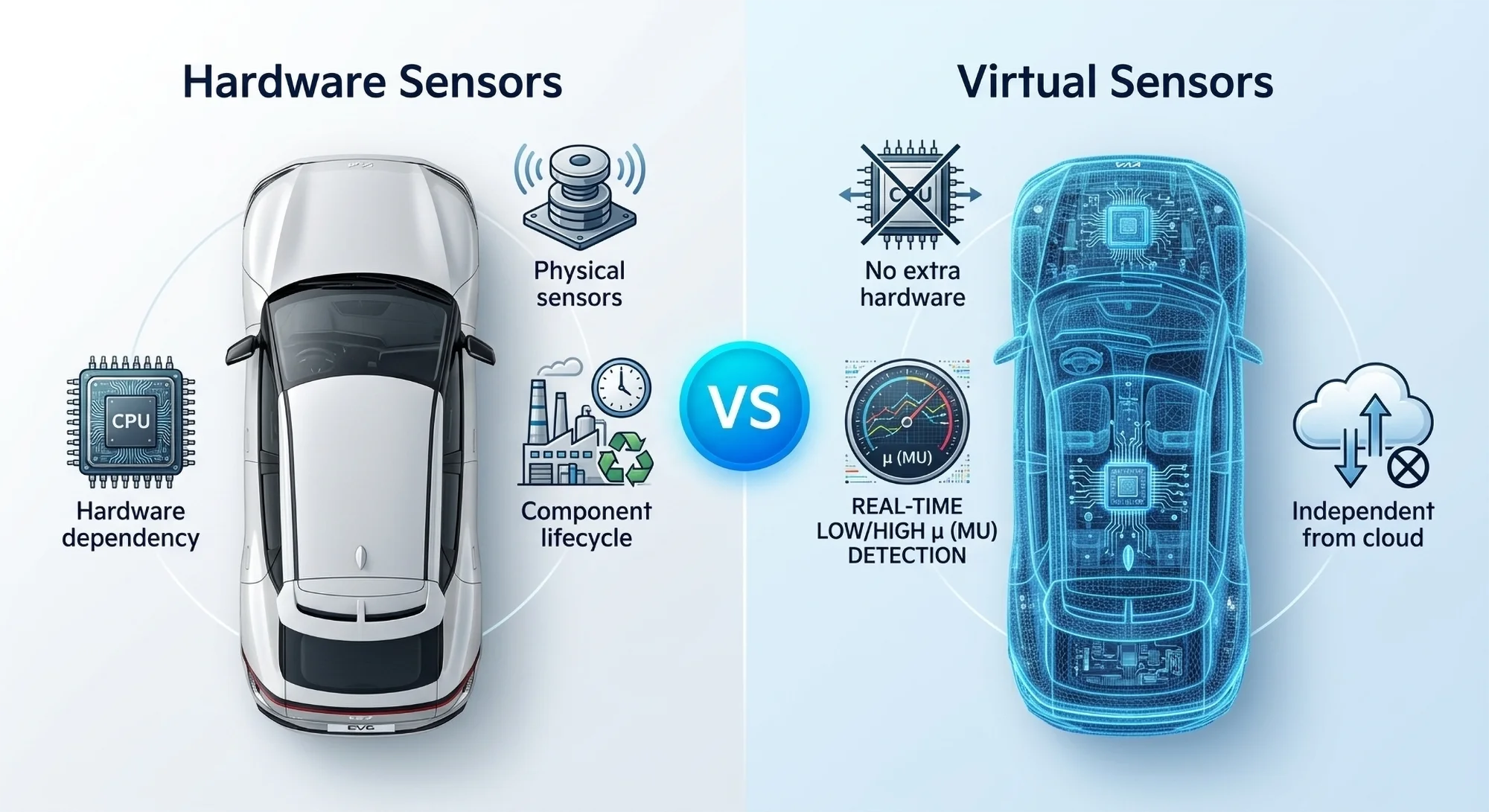
Easyrain’s DAI (Virtual Sensor Platform) addresses this gap directly. Operating without additional hardware, DAI analyzes existing vehicle dynamics signals – wheel speed, inertial data, steering inputs – to detect aquaplaning, snow, ice, and grip reduction in milliseconds, before tire slip occurs. This approach introduces what Easyrain defines as a “haptic sense,” providing the friction-awareness layer that conventional camera-radar-LiDAR architectures lack.

The practical implication is that ACC, AEB, and Highway Assist systems receiving DAI data can adjust their intervention thresholds dynamically. Rather than applying a fixed braking force regardless of surface conditions, these systems gain the ability to modulate their response based on real-time grip estimation – turning standard ADAS into friction-adaptive ADAS.
From Detection to Active Intervention
Where DAI provides the data layer, Easyrain’s AIS (Active Safety System) acts on it. AIS is an active system designed to restore grip on wet surfaces by eliminating the water layer ahead of the tires. Its measured results include a 20% reduction in braking distance on heavy wet surfaces and a 225% increase in lateral traction under aquaplaning conditions – operating where ABS and ESC reach their physical limits.
Scaling Through Cloud Intelligence
At the network level, ERC (Cloud Infrastructure) aggregates real-time grip and road condition data from equipped vehicles, building live friction maps. This shared intelligence enables predictive hazard warnings, fleet-wide risk monitoring, and data-driven road maintenance planning for municipalities.
The Regulatory Context: Euro NCAP 2026
The industry trajectory aligns with regulatory pressure. The Euro NCAP Vision 2030 roadmap introduces testing protocols that require vehicles to demonstrate ADAS reliability under adverse weather and low-grip conditions. Achieving top safety ratings will increasingly require vehicles to differentiate between dry asphalt and icy or wet surfaces – effectively mandating some form of real-time friction estimation.
This shift confirms that data quality, measured at the tire-road interface and delivered in milliseconds, is becoming a structural requirement for next-generation vehicle safety – not an optional enhancement.