Worn Winter Tires Below 4 mm: What ADAC Test Data Reveals About Aquaplaning Risk and Braking Distance

The Tread Depth Threshold That Changes Everything
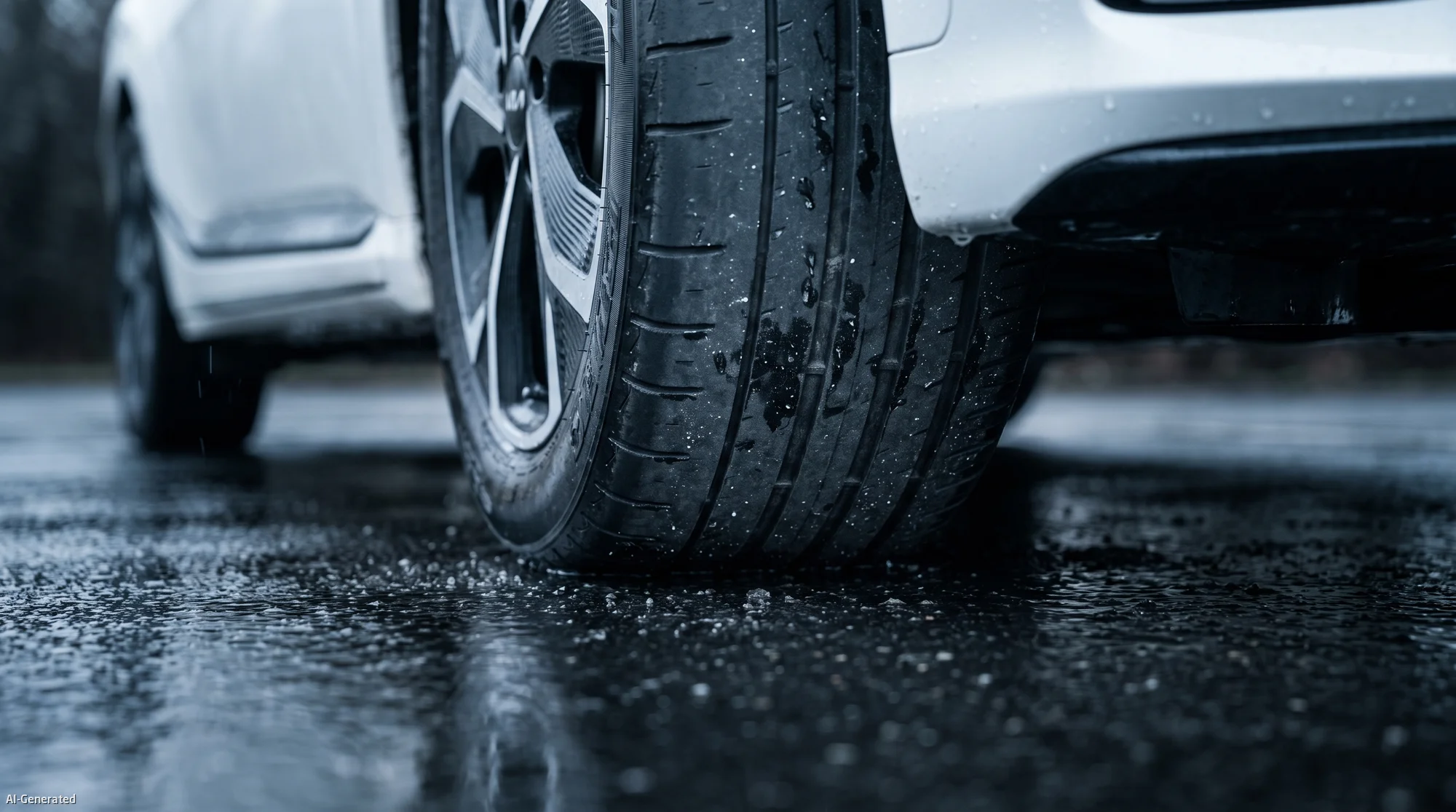
A tire with 2 mm of remaining tread is legal in most of Europe. According to empirical testing by ADAC, the German automotive safety organization, it is not safe. A controlled laboratory study measuring five winter tire models in size 185/65 R15 – a standard fitment for compact vehicles including the VW Polo, Renault Clio, and Opel Corsa – found that worn tires near the legal minimum produce catastrophic losses in aquaplaning resistance and wet handling performance that drivers have no perceptible warning of before a critical event occurs.
The test, published by ADAC Technik Zentrum, examined the same tires in three states: new (approximately 8 mm tread), partially worn (4 mm), and critically worn (2 mm). To isolate the effect of tread depth from rubber aging or compound degradation, tires were mechanically buffed to each target depth under controlled conditions.
What the ADAC Tests Found
At 4 mm Tread: Safety Reserves Are Already Depleted
At 4 mm – ADAC’s recommended replacement threshold for winter tires – performance degradation is measurable across all wet-weather metrics, even if drivers rarely notice it in routine driving:
- Longitudinal aquaplaning resistance drops by 12% versus new tires
- Lateral aquaplaning resistance in cornering conditions falls by nearly 25%
- Wet handling score deteriorates from 2.4 (Good) to 3.4 (Satisfactory) on ADAC’s 1–5.5 scale
- Snow braking distance (from 30 km/h) extends by 12.4%
The deceptive element at 4 mm: straight-line wet braking distances remain largely unchanged. This consistency masks the significant loss of lateral stability, giving drivers an inaccurate picture of the tire’s actual safety envelope.
At 2 mm Tread: Performance Collapse
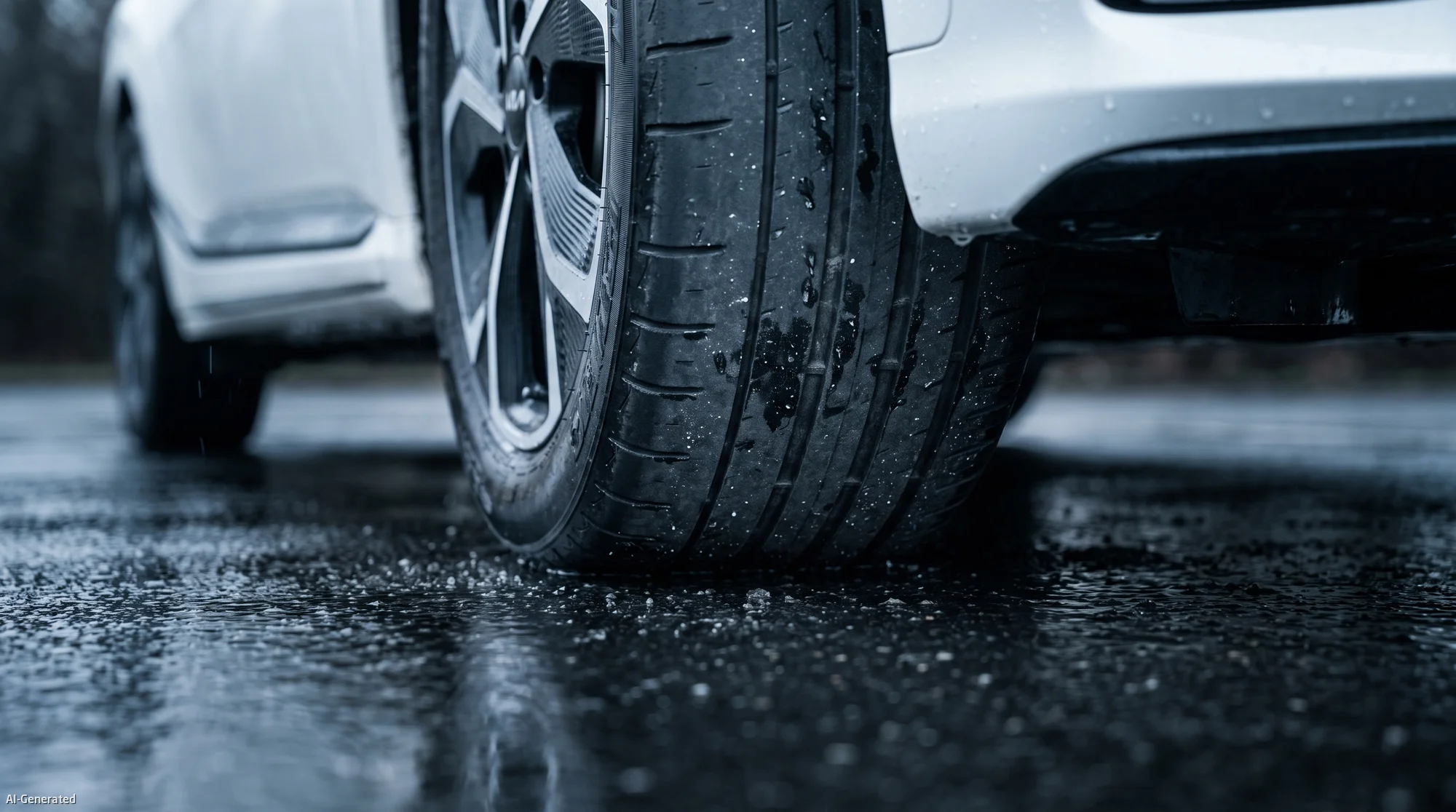
Below 4 mm, degradation accelerates non-linearly. Between 4 mm and 2 mm, the test documented losses that exceed those recorded across the entire interval from new to 4 mm:
- Longitudinal aquaplaning resistance: −22% versus new tires. The best-performing tire in the test maintained contact with the road up to approximately 93 km/h when new; at 2 mm, it aquaplaned at 77 km/h – a 16 km/h reduction in the safe speed threshold
- Lateral aquaplaning resistance: average loss of more than 52%, causing sudden breakaway in wet curves even at moderate speeds
- Wet braking distance: increases from 31.9 m to 37.3 m – an additional 5.3 meters (+17%) over the stopping distance of a new tire
- Wet handling score: drops to 4.7 (Deficient), beyond the satisfactory range
- Snow braking distance: extends by 20.5%; at the point of complete stop for a new tire, the 2 mm tire is still traveling at approximately 15 km/h
- Snow handling score: reaches 7.2, exceeding the ceiling of ADAC’s standard rating scale
Why It Matters: The Statistical Scale of the Problem
Tire wear is not an edge-case risk. According to NHTSA technical report DOT HS 811 617, tire problems appear in approximately 9% of all light-vehicle pre-crash phases in the United States. Vehicles with tread depths at or below 2/32 inches (≈1.6 mm) are three times more likely to experience a tire-related critical event before a crash compared to tires with 3–4/32 inches of tread. NHTSA attributes roughly 11,000 motor vehicle crashes and more than 500 fatalities per year to tire-related factors.
In the United Kingdom, the Department for Transport’s Reported Road Casualty Statistics consistently identifies illegal, defective, or under-inflated tires as the single most common vehicle-defect contributory factor in fatal and serious injury collisions – accounting for 25% to 30% of all crashes where a vehicle defect is recorded.
DEKRA’s vehicle safety analysis confirms that reducing tread depth to 2–3 mm lowers the critical cornering speed on wet surfaces by 10–18%, undermining the intervention envelope of electronic stability control systems at speeds above 80 km/h.
Key Data at a Glance
- −22% longitudinal aquaplaning resistance at 2 mm vs. new
- −52% lateral aquaplaning resistance at 2 mm vs. new (cornering)
- +5.3 m additional wet braking distance at 2 mm (from 31.9 m to 37.3 m)
- +20.5% longer snow braking distance at 2 mm
- 3× higher tire-related crash probability at ≤1.6 mm tread (NHTSA)
- 25–30% of vehicle-defect road fatalities linked to tire condition (UK DfT)
- 4 mm: ADAC’s official recommended minimum tread depth for winter tires

The Technological Response: Real-Time Detection and Active Intervention
The ADAC data identifies a structural limitation in conventional safety systems: ABS, ESC, and stability control all operate reactively – they respond to loss of grip after the tire has already begun to fail. At 2 mm tread depth, the margin between normal driving and uncontrollable aquaplaning is so narrow that reactive systems have insufficient time to intervene effectively.
Two distinct technology categories address this gap from different points in the intervention chain.
Easyrain’s DAI (Virtual Sensor Platform) operates without added hardware, analyzing wheel dynamics and vehicle behavior in real time to detect aquaplaning – including partial aquaplaning – within milliseconds. DAI also integrates a Virtual Sensor Tire Wear module that continuously estimates tread depth to 0.5 mm accuracy by analyzing vehicle dynamics and wheel behavior, providing drivers and ADAS systems with a live risk assessment tied directly to the actual state of the tire.
Easyrain’s AIS (Active Safety System) acts as the first active countermeasure capable of restoring grip before control is lost. By projecting pressurized fluid ahead of the tire contact patch, AIS eliminates the water layer responsible for aquaplaning, reducing braking distance by 20% and increasing lateral traction by 225% in full-aquaplaning conditions. This enables safe dynamics even with tires whose tread depth has entered the high-risk zone.
Easyrain’s ERC (Cloud Infrastructure) aggregates real-time grip and hazard data from connected vehicles to produce predictive road condition maps, enabling fleet operators and city traffic management systems to anticipate high-risk zones and plan maintenance or routing accordingly.
Recommendations and Regulatory Context
ADAC’s recommendation is unambiguous: replace winter tires when tread depth reaches 4 mm, well before the European legal minimum of 1.6 mm. The test data confirms that the 4 mm threshold is not conservative – it marks the beginning of a non-linear performance collapse on wet surfaces.
Country-specific regulations in Europe impose stricter standards in several jurisdictions. Austria and the Czech Republic require a minimum of 4 mm tread depth for winter tires to be classified as such under winter road conditions. Finland mandates a minimum of 3 mm for studded winter tires.
For drivers in the 185/65 R15 fitment range – and by extension for the broader population of compact car owners – the practical recommendation that emerges from ADAC’s data is straightforward: a €2 coin inserted into the main tread groove is 4 mm wide. If the silver rim is visible, the tire has reached ADAC’s replacement threshold and should be changed before the next winter season begins.